Project life
What does research have to say about mountains in 2025?
 @ Leïla Shahshahani
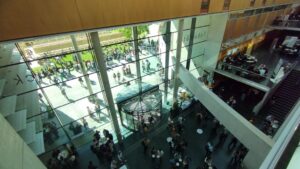
This year, you had to be in Innsbruck, Austria, to take the pulse of global mountain research. Scientists mingled in the aisles of the International Mountain Conference from September 14 to 19, 2025.
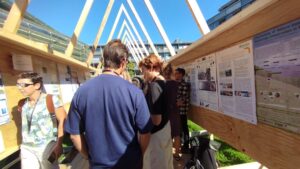
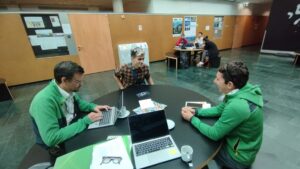
The marathon lasted four days, during which more than a thousand researchers from all disciplines, from the environmental sciences to the humanities and social sciences, and from 67 countries, presented their recent work and discovered that of their counterparts, all with one thing in common: the mountains. And the desire to forge links and explore new possibilities for collaboration.
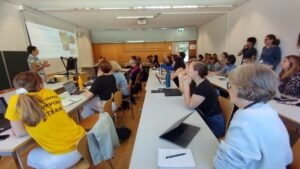
The exercise required a sprinter’s skill, some being more seasoned than others: presenting one’s research project or thesis in seven minutes – slides and stopwatch in hand – to an unknown and motley crew. And to play the question-and-answer game in the short time available. ” The idea of this condensed format is to enable everyone to present or discover, in broad outline, the projects of each and every one. And, thanks to this first approach, to be able to identify possible avenues of collaboration, or simply opportunities for exchange “, explains Wolfgang Gurgiser, coordinator of the Mountain Regions Research Department at the University of Innsbruck and organizer of the event.
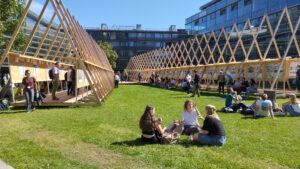
Another major challenge remained: choosing sessions from among the 160 often simultaneous events on offer, and moving from one to the next while optimizing travel within the University buildings. All this without neglecting the informal breaks, which are particularly conducive to networking.
This is the third time Innsbruck has hosted the event, recognized as the largest international conference on mountain research. While the first edition registered 500 participants in 2019, there were 1,200 in attendance this year. Among them were some 20 researchers from Labex ITTEM, 12 of whom led or co-lead sessions on various themes: digital transition in outdoor sports, management practices in protected areas, living well in the mountains, tourism and sustainable management in mountain refuges, transition of mountain resorts…
The ambition of theInternational Mountain Conference is to offer a ” synthesis of knowledge of mountain environments to improve understanding and possible responses in the context of global climate change “. But what about the facts? What can we say about mountain research in 2025? At the risk of disappointing readers, we won’t be looking for any big scoops to grab the headlines. Rather, as each issue unfolds, we’ll be looking for emerging trends that, in their own way, tell the story of the evolution of mountain research.
Whereas the humanities and social sciences accounted for only 10% of the disciplines presented in the early days, they now account for around a third. In terms of themes, Wolfgang Gurgiser notes that many of this year’s papers focus on the challenges posed by a two-fold observation: a sharp increase in visitor numbers in many mountain areas, already weakened by the effects of climate change. What are the risks? How can we reconcile these two phenomena?
Another developing dimension in the field of investigation is research into the “human-non-human” relationship, placing human beings in a relationship of interdependence with their environment. ” This year, the theme of wool has also been invited to the conference, and although it doesn’t involve a significant number of researchers, it bears witness to the emergence of new subjects that we are keen to showcase “, enthuses Wolfgang Gurgiser. He also concedes that there are some “holes” in the line-up, noting that the African and Asian regions are under-represented.
Last but not least, this year’s International Mountain Conference was keen to get closer to current mountain affairs, with an event devoted to the Blatten disaster – a Swiss village in the Lötschental (Valais) destroyed by an avalanche of scree and ice on May 28, 2025 – in the presence of several experts.
The next event will take place from September 10 to 14, 2028.