

Alpine forests, climate change and territorial transitions
Début du projet : 2025How can we think about the relationship between science and society when it comes to mountain forest socio-ecosystems, and link scientific expertise and social issues from a social science perspective? The 2025 edition of the Croscus educational project plunges into the heart of the environmental, economic and social challenges facing Alpine forests in the Aravis mountains.
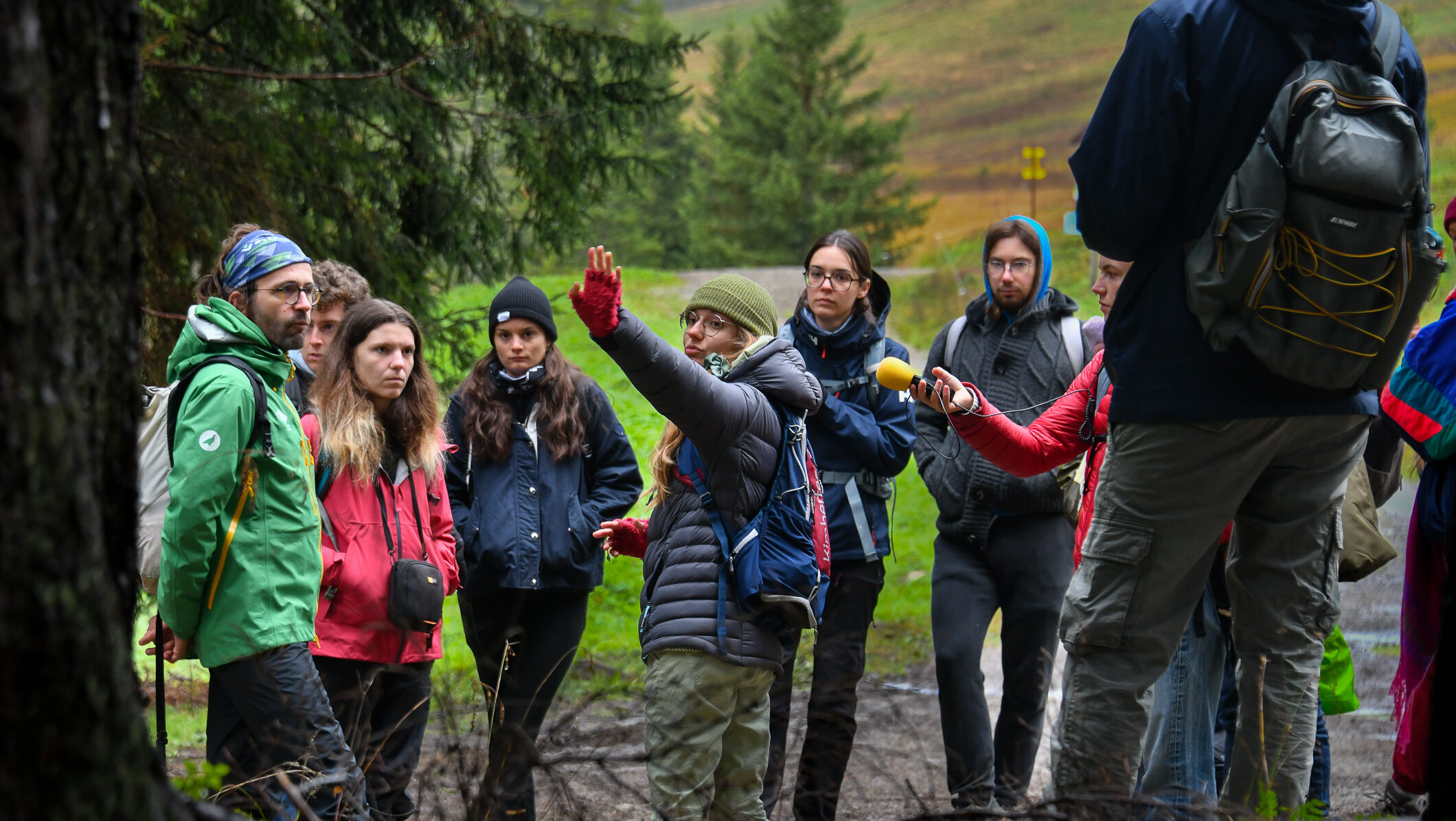 © Alexandra Blin
The project, run by the Master’s degree in Scientific and Technical Communication and Culture (CCST) at Grenoble Alpes University, aims to analyze contemporary issues in the cultural mediation of science and nature in society. Using the case of mountain areas, the aim is to understand the growing complexity of these relationships, and to define what we call “science”, “scientific culture” and “audiences”. Scientific and ecological issues have gone beyond the confines of research institutions to become public problems, addressed by experts, professionalized communication, associations and public action.
Each year, the Croscus project focuses on a different theme in an Alpine region. After the wolf in 2019, flora conservation in 2021, transnational mobility in 2022, gypsum quarries in 2023 and the management of living organisms in 2024, this year’s focus is on mountain forests and their management in the face of climate change. The base camp will be set up in Thônes in the Aravis mountains (Haute-Savoie).
Adopting a distanced, reflexive and symmetrical stance with regard to the interplay of actors and arguments, this immersion should enable us to grasp the complexity and hybrid nature of mountain forest management situations and the ways in which they relate to other local issues (tourism, agriculture, biodiversity) and the tensions that emerge. Or how understanding the complexity of relationships with nature and forms of management of the non-living, and the associated imaginaries and narratives, cannot be reduced to strictly technical, scientific or deterritorialized answers.
The project articulates several pedagogical formats (field survey, research seminar and creative workshop) that can give rise to various forms of scientific communication and mediation: a popular science video as well as scientific communication proposals for local forest stakeholders and for the “Alpine Forests and Ecological Transition” symposium organized by Grenoble Alpes Métropole and the Grenoble Alpes University Foundation.
Training Aravis Natural areas, resources and biodiversity
Coordination

Mikaël Chambru
Gresec (UGA)


